RSS

Greater Vancouver Is Having a Sale — And You're Looking at the Receipts

Greater Vancouver Market Report Here

Metro Vancouver Market Report     Here 

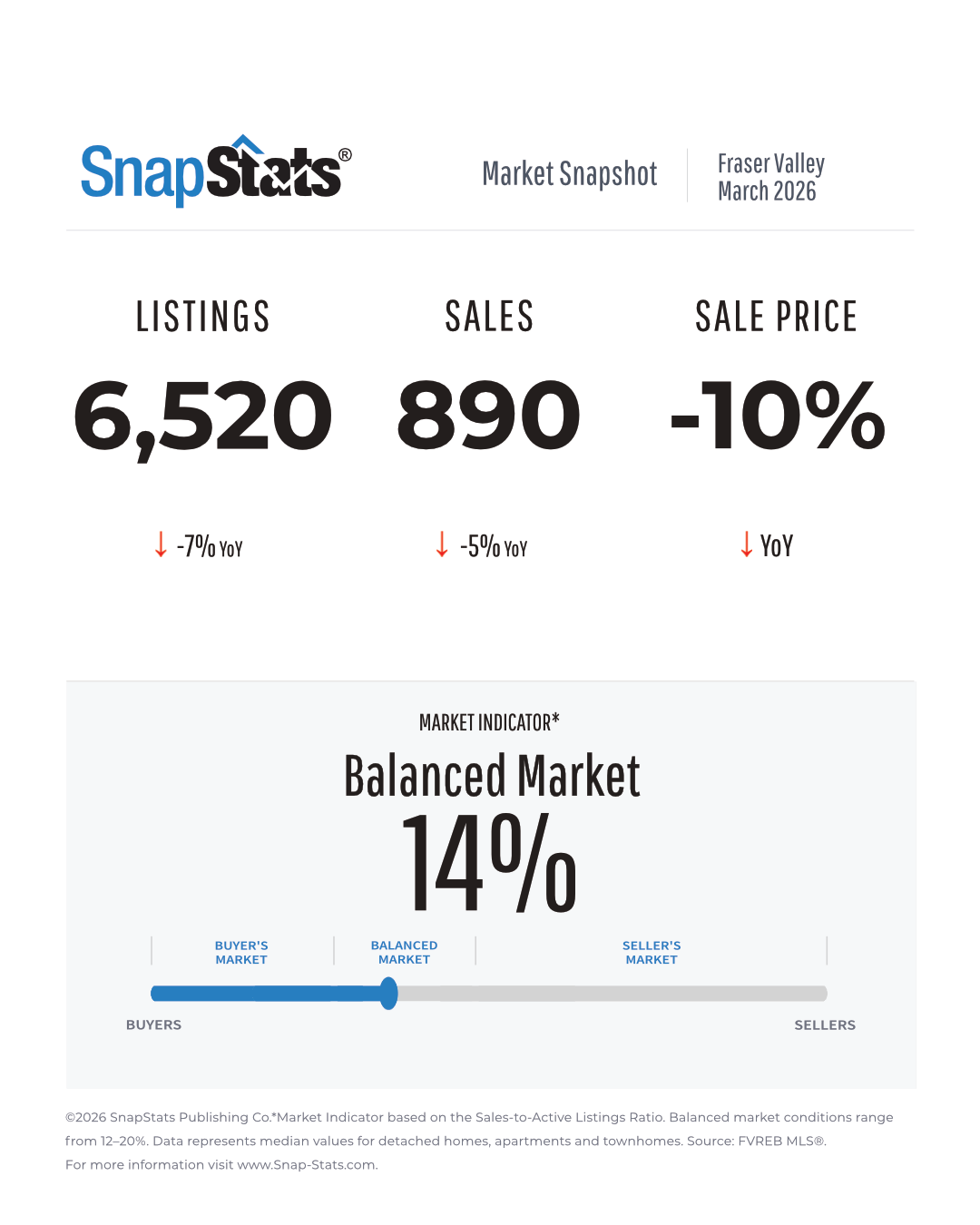
Fraser Valley Market Report              Here

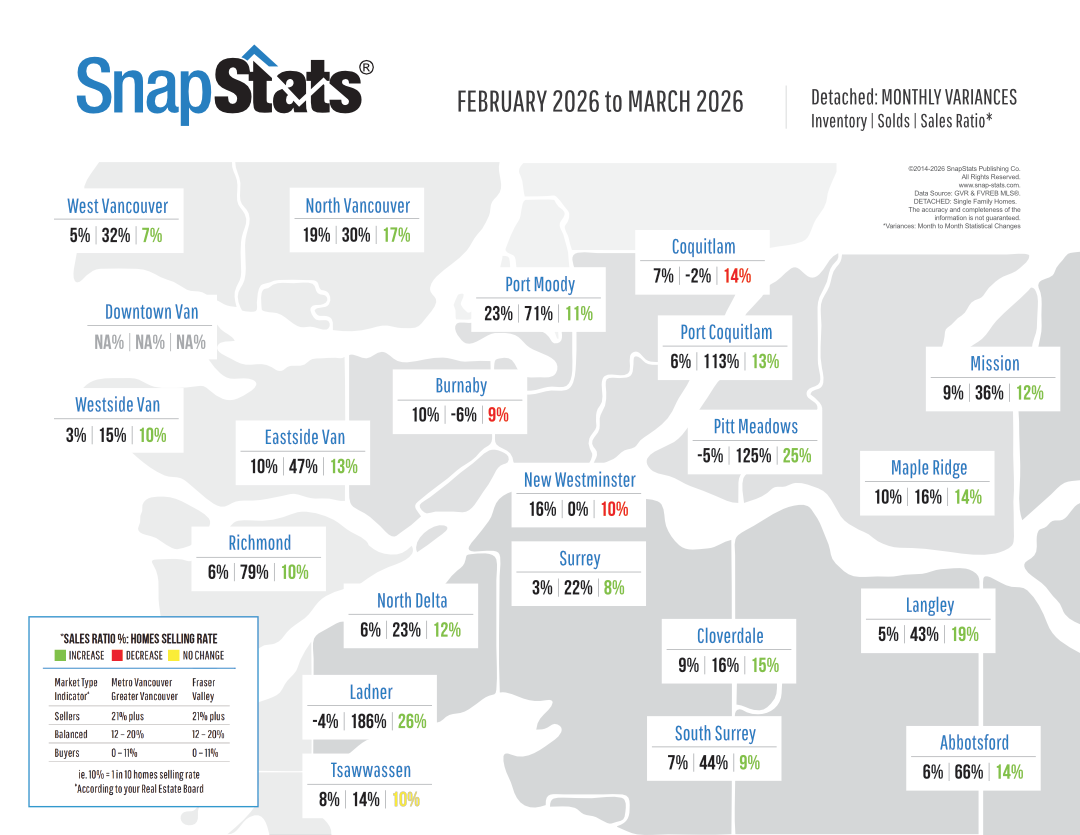
Detached Monthly Variance              Here

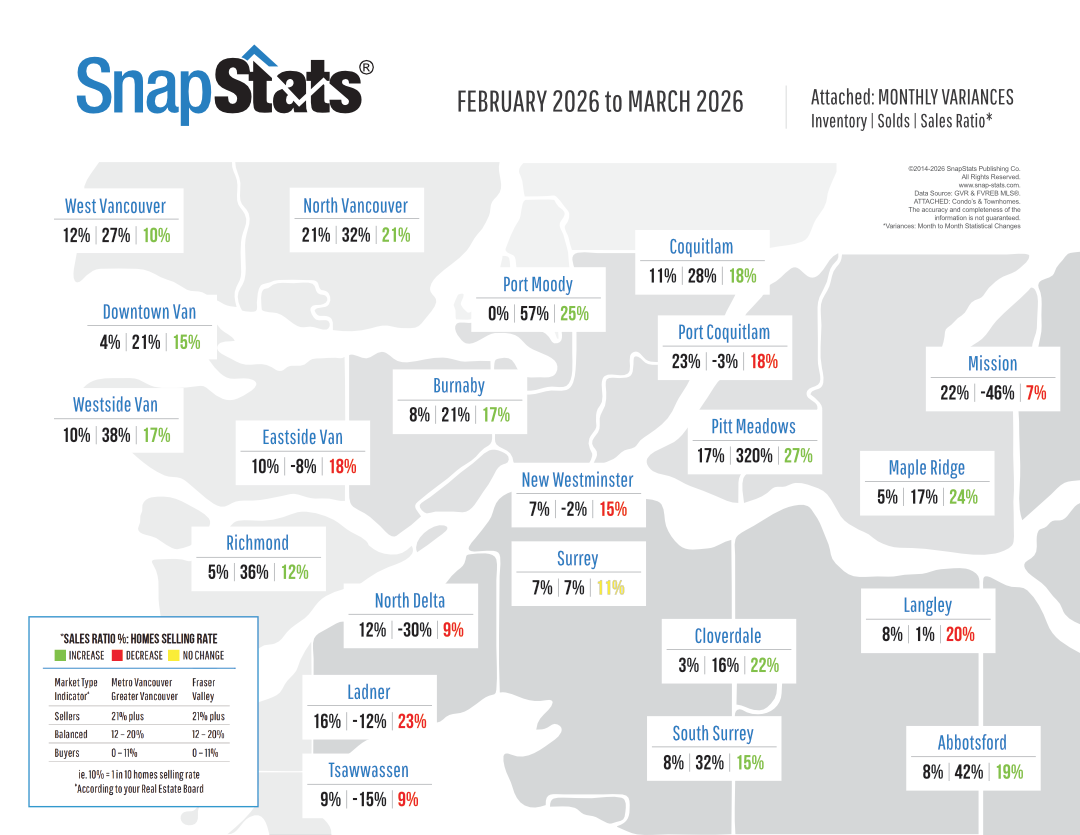
Attached Monthly Variance               Here

Read the Full Report                              Here 

The April 2026 numbers just dropped, and they're telling a story most buyers don't want to hear: the window is starting to close.

Here's what the data actually says — and why waiting could cost you.

1. Prices are down across the board — but the detached segment is already turning

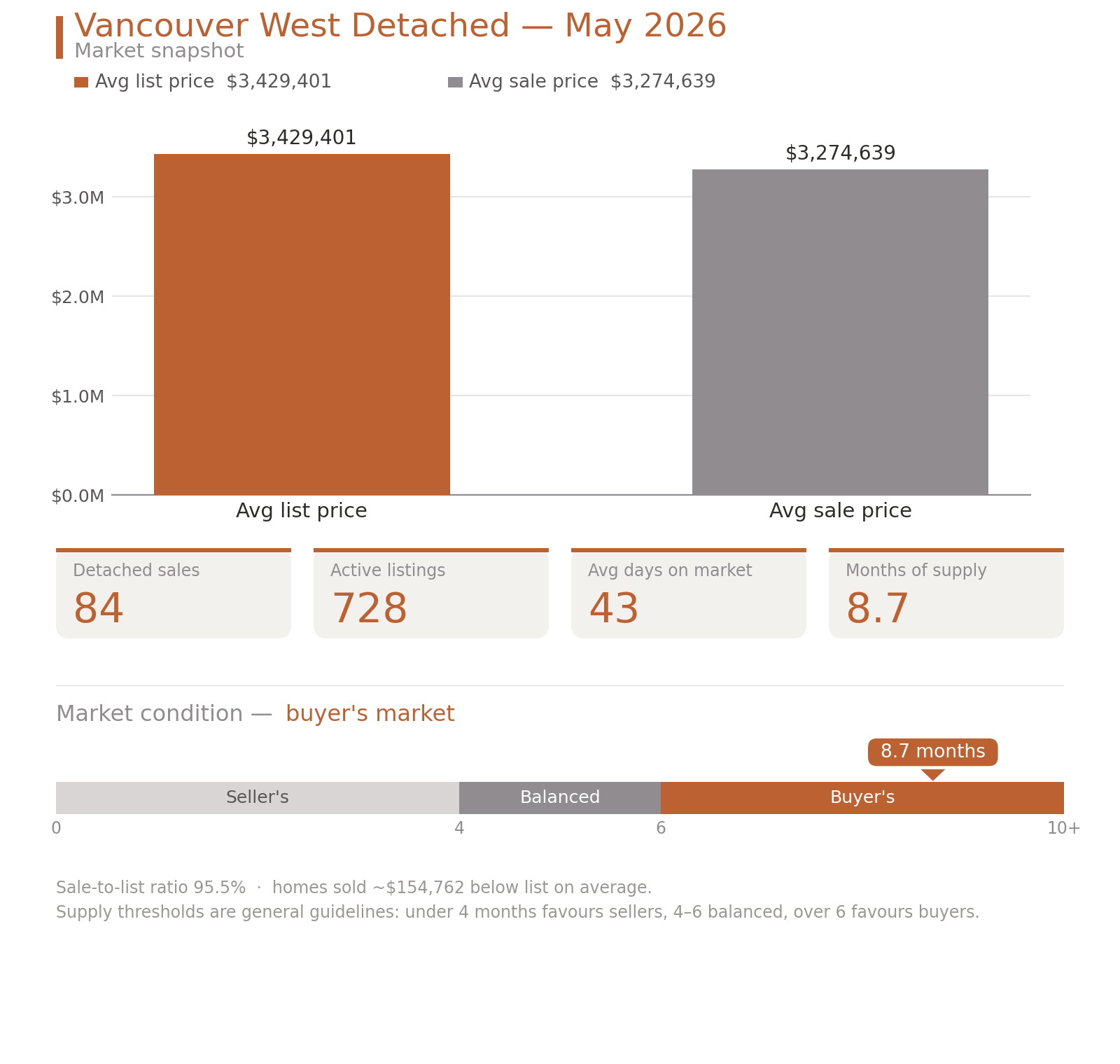
Metro Vancouver's composite benchmark sits at $1,098,000 — down 6.9% from a year ago. Vancouver West detached homes are down 11.6% YoY. But here's the catch: detached prices ticked up 1.9% in the last month and 0.8% over three months. The bottom isn't a bell you hear ringing — it's a chart you only recognize in the rearview mirror.

2. Detached sales jumped 14% across the region

Vancouver West detached sales are up 21.2% year-over-year. Over the last three months, they're up 28.6%. When sales rise before prices do, it's the classic early signal that buyers are quietly stepping back in.

3. The chief economist of Greater Vancouver REALTORS® said it out loud

Andrew Lis: detached homes have historically acted as a bellwether for the broader market — and he expects multi-family to follow. Translation: the condo and townhome discount you see today may not be there in six months.

4. Condos are on the deepest discount right now

Vancouver West has 1,688 active condo listings — a buyer's pick of the litter. Benchmark condo price: $790,300, down 6.8% YoY. This level of selection rarely lasts once sentiment shifts.

5. Townhome medians are already climbing

Vancouver West townhome median sale price: $1,699,900 in April, up from $1,448,000 a year ago. Buyers are quietly paying more for townhomes — the segment is moving before the headlines catch up.

6. Inventory is 37.9% above the 10-year seasonal average

That's historic-level selection. More choice. More negotiating power. More time to inspect, compare, and walk away from the wrong one. None of that exists in a hot market.

7. The sales-to-active ratio is sitting at 13.5%

Just above the 12% threshold where prices typically start climbing again. We're sitting on the line. One strong month flips the script.

8. Interest rate cycles don't wait for buyers to feel ready

When rates drop further and sidelined demand re-enters, all three segments compete for the same shrinking inventory. The "deal" disappears in weeks, not months.

9. The best properties go first — always

Even in a soft market, well-priced homes in prime Vancouver West pockets move. The "wait and see" buyer doesn't get the corner lot, the south-facing balcony, or the renovated kitchen. They get what's left.

10. You can't time the bottom — but you can recognize the setup

Falling prices + rising sales + tightening ratio + economist forecasting a turn = the textbook definition of opportunity window.

Don't be the person in 2027 saying "I should've bought in spring 2026."

Call me to talk strategy, see what's listed, or pull comps for your neighbourhood.

Rob Britch REMAX Select Realty 604-240-5813 rob@robbritch.com

Read

Opportunity knocks in Metro Vancouver’s Spring Market

What the market is telling us

The overall market is stable and measured — sales are tracking closely to 2025 levels, prices are essentially flat month-over-month, and a healthy supply of homes is available. Beneath that calm surface, one segment is standing out: detached homes are showing real momentum, with sales up more than 8% year-over-year and new listings actually declining from last year. That's a meaningful signal for anyone watching the detached market closely.

Great news for Buyers

This is the most buyer-friendly environment Metro Vancouver has offered in years. Here's why this moment matters:

Inventory is 38% above the 10-year seasonal average — more homes to choose from than in most recent springs.

Prices are essentially flat month-over-month across all property types, giving buyers a stable foundation to negotiate from.

Apartment benchmark at $706,700 is down 7.8% from a year ago — entry-level purchasing power hasn't been this strong in some time.

The sales-to-active-listings ratio of 14.2% sits comfortably in balanced territory — no bidding-war pressure.

Great news for Sellers

A slowing market is not a bad market for prepared sellers. The current conditions are working in your favour:

New listings dropped 10.3% from last March — competition among sellers is actually easing, not growing.

Detached home sales rose 8.3% year-over-year — motivated buyers are active and transacting in the detached segment.

Month-over-month prices ticked upward for detached (+1%) and townhouses (+0.1%), signalling prices are holding.

Sellers who price well and present well are still selling — 2,032 sales happened in March alone.

The Bigger Picture

The wait-and-see mood in the market won't last forever. Geopolitical factors — including bond yield pressure from the Middle East conflict — are creating short-term uncertainty, but history shows that Metro Vancouver real estate consistently rewards those who act with conviction during quieter periods. The 10-year composite price change of +15.4% for Greater Vancouver tells the story of a resilient, long-term market.

Whether you're a buyer ready to take advantage of today's selection and stable prices, or a seller whose well-prepared home stands out in a less-crowded field — this spring market has something to offer you.

Click Here to Learn More 

Read

What Today’s Metro Vancouver Market Is Really Telling Us

We are currently seeing a noticeable increase in the number of homes available for sale, while overall sales activity remains below long-term averages.

When this combination occurs, the market often begins to create opportunities.

Our expectation is that home values will likely level out this year, while the number of transactions gradually improves as buyers adjust to current interest rates.

With rates down from their peak and more homes to choose from, many buyers are starting to re-enter the market.

Vancouver real estate rarely goes “on sale,” but periods like this can quietly open windows of opportunity — particularly for first-time buyers or those considering their next move.

For homeowners looking to trade up, the gap between selling and buying has narrowed, making it easier to move to a better location, a larger home, or a newer property.

And for those who simply need to sell, careful positioning and pricing can still produce excellent results in today’s market.

If you are thinking about making a move — now or later this year — I would be happy to share a few ideas based on what we are currently seeing.

Out of curiosity — do you feel the market right now is creating more opportunity for buyers, sellers, or both?

Feel free to reach out anytime. And if someone you know might benefit from this update, please feel free to pass it along.

Read

A Healthier, More Balanced Housing Market Taking Shape in Metro Vancouver

Vancouver West Report                                  Here

Vancouver East Report                                    Here

Read the Full Report                                           Here

Greater Vancouver Market Report             Here

Metro Vancouver Market Report                 Here

Fraser Valley Market Report                          Here 

Detached Monthly Variance                          Here

Attached Monthly Variance                           Here 

Is the Vancouver Housing Market Stabilizing?

Metro Vancouver Real Estate Market Update – February 2026

The Metro Vancouver housing market is continuing to shift toward more balanced conditions as we approach the spring market. Buyers are seeing more selection, while sellers still benefit from steady demand.

3 Key Market Stats

1. Sales Activity
There were 1,648 homes sold in February 2026, about 9.8% fewer than February last year. GVR-Stats-Package-February-2026

2. More Homes for Sale
There are currently 13,545 homes listed across Metro Vancouver, which is 37% above the 10-year seasonal average. GVR-Stats-Package-February-2026

3. Home Prices
The benchmark price across all residential property types is $1,100,300.

Benchmark prices by property type:

  • Detached homes: $1,835,900

  • Townhomes: $1,046,100

  • Apartments: $708,200

What This Means

The sales-to-active listings ratio is currently 12.6%, suggesting the market is moving toward balanced conditions.

For buyers, this means more choice and less competition than in recent years.
For sellers, well-priced and well-presented homes are still attracting serious buyers.

As we move into the spring market, increased buyer activity could help stabilize inventory and support prices.

Thinking of Buying or Selling?

With over 33 years of experience in Vancouver real estate, I help clients navigate changing markets with clarity and confidence.

If you’re considering a move, feel free to reach out for a personalized market strategy based on today’s conditions.

Rob Britch
RE/MAX Select Realty
📞 604-240-5813
🌐 robbritch.com

Read

BC’s Property Tax Deferment Program Is Changing in 2026

For years, many retired homeowners have used BC’s Property Tax Deferment Program as a practical cash-flow tool in retirement. It allowed seniors to reduce immediate housing expenses and manage rising property taxes while living on a fixed income.

Under the Regular Program, deferred taxes were charged at Prime minus 2% using simple interest, making it an attractive, low-cost option.

That changes beginning with the 2026 tax year.

As part of Budget 2026, any new property taxes deferred going forward will be charged at:

Prime + 2% with monthly compounding interest

What That Means

  • Interest will accrue at 2% above Prime

  • Interest will be compounded monthly

  • Each month’s interest will be added to the outstanding balance

  • Future interest will be charged on that growing balance

Deferred balances from 2025 and earlier will remain under the previous terms. However, homeowners enrolled in automatic renewal will have their 2026 taxes deferred under the new structure unless they opt out before their municipal property tax deadline.

Why This Matters

From a planning perspective, this represents a significant shift.

What was once a below-market government advance is now structured more like long-term secured borrowing. Because the interest compounds, the deferred balance can grow more quickly over time — reducing home equity until the amount is repaid upon sale or refinance.

A Simple Example

Let’s assume:

  • Annual property taxes: $18,000

  • Prime rate: 6% (for illustration)

  • New deferment rate: Prime + 2% = 8%

  • Interest compounded monthly

Year 1

$18,000 deferred at 8% compounded monthly
After one year, the balance would be approximately:

$19,494

That’s about $1,494 in interest in the first year alone.

After 5 Years (Deferring $18,000 Each Year)

If a homeowner deferred $18,000 annually for five consecutive years at 8% compounded monthly, the total deferred balance would grow to approximately:

$114,000–$120,000+

Of that amount, roughly $24,000–$30,000 would be interest, depending on rate fluctuations.

And because interest compounds, the cost accelerates over time.

For some homeowners, the program may still make sense. But it’s no longer the low-cost cash-flow strategy it once was, and it warrants a closer review within a broader retirement and estate plan. 

If you’re wondering how these changes may impact your long-term plans, I’m always available to have that conversation. While I can’t provide financial advice, I can help you understand how this may affect your real estate equity and overall strategy. And if needed, I’m happy to connect you with a trusted financial advisor who can review your specific situation and discuss your options in detail.

As always, my role is to make sure you have the right information to make informed decisions.

.

Read

Why 2026 is a Strategic Time to Buy or Sell in Metro Vancouver

Vancouver West Report                     Here

Vancouver East Report                       Here

Read the Full Report                            Here 

Greater Vancouver Market              Here

Metro Vancouver Market                  Here

Fraser Valley Market                           Here

Why This Is a Great Time to Buy and Sell

Despite quieter headlines, today’s market conditions are actually creating rare advantages on both sides of the transaction.

For Buyers: More Choice, More Leverage, Better Decisions

  • Inventory levels are well above historical averages, giving buyers more options and time to make thoughtful decisions.

  • Reduced competition means less pressure, fewer bidding wars, and stronger negotiating power.

  • Stable pricing allows buyers to enter the market without fear of overpaying, particularly in well-located, quality properties.

  • This environment rewards prepared, decisive buyers who can secure strong long-term value.

For Sellers: Serious Buyers, Real Pricing, Clean Deals

  • While overall sales volumes are lower, motivated buyers are still active—especially for well-priced, well-presented homes.

  • A more balanced market filters out casual buyers, leading to more qualified showings and smoother transactions.

  • Sellers who price strategically can stand out quickly and avoid the volatility of overheated markets.

  • Today’s conditions reward sellers who focus on strategy over speculation.

Why This Market Is Healthy

  • The sales-to-active listings ratio signals a stable, balanced market, not a crash.

  • Prices are being supported by steady demand and controlled inventory growth.

  • Market momentum is evolving—not stopping—creating predictability rather than chaos.

The Big Picture

Markets like this favour experience, strategy, and timing.
For buyers, it’s a chance to secure value.
For sellers, it’s an opportunity to attract serious buyers and transact with confidence.

Questions about the Market?

Rob Britch | RE/MAX Select Realty
📞 604-240-5813  ✉️ rob@robbritch.com  🌐 robbritch.com
Metro Vancouver Realtor® | 33 Years of Experience

Read

Rules around Short Term Rentals (AirBnb - VRBO)

Across Metro Vancouver and surrounding areas like North Vancouver, West Vancouver, the Tri-Cities (Coquitlam, Port Coquitlam, New Westminster) and most Gulf Islands, short-term rentals such as Airbnb are now tightly regulated. In urban municipalities, they are generally only allowed in a host’s principal residence, require provincial registration, a municipal business licence, and compliance with strata and zoning rules. Operating an unlicensed or non-principal-residence Airbnb can result in significant fines, often up to $3,000 per day per offence, plus listing removal. Some smaller Gulf Islands may have partial exemptions from the principal-residence rule, but local bylaws and permits still apply, and enforcement is increasing across the region.

Click Here to Learn More 

Click Here for the Provincial Government Website 

Read

2026 Property Assessments are out

2026 property assessments have now been delivered. Although many homes show slight decreases in value from last year, that doesn’t necessarily mean your property tax bill will fall — in fact, you may still face higher taxes.

In BC, your tax bill equals your assessed value multiplied by a municipal tax rate. Municipalities set that rate to fund their budgets, which have generally risen across the province. Even when a city reports a “flat” municipal budget, overall tax rates can increase once regional and other levies are added.

Assessments aren’t final — you have until 02/02/2026 to file an appeal. Typical reasons to appeal include incorrect property type or a valuation that’s out of line with similar homes. Assessors use broad, automated valuation methods that work across many properties but can overlook home-specific problems such as deferred maintenance or highest and best use.

It’s important to check your assessment every year, especially after market shifts. Winning an appeal may lower your taxes for the current year and subsequent years.

If you haven’t received your assessment, scan the QR code to view it. If you’d like a current market valuation or help deciding whether to appeal, contact me to arrange a consultation.

Appeal deadline: 02/02/2026.

Read

Metro Vancouver Market Snapshot – A Reset Creating Opportunity

Vancouver West Report         Here 

Vancouver East Report           Here

Greater Vancouver Report   Here

Read the Full Report                 Here 

Greater Vancouver Market   Here

Metro Vancouver Market      Here 

Metro Vancouver Market Snapshot – A Reset Creating Opportunity

While 2025 recorded lower overall home sales in Metro Vancouver, the year also marked an important market resetthat is laying the groundwork for improved conditions ahead.

Sales activity totalled approximately 23,800 homes, reflecting a quieter year by historical standards. However, one of the most notable developments was on the supply side: sellers brought a record number of homes to market, the highest level of new listings since the mid-1990s. This expanded inventory has given buyers significantly more choice than they’ve had in many years.

Active listings finished the year well above long-term averages, creating a more balanced marketplace and easing the intense competition that defined prior cycles. At the same time, borrowing costs declined by nearly a full percentage point, helping to offset some of the price adjustments seen in 2025.

Home prices softened modestly across all property types, which has improved overall affordability without triggering sharp or destabilizing corrections. Benchmark prices remain historically strong, reflecting the region’s long-term demand fundamentals.

Economic uncertainty and trade tensions impacted confidence earlier in the year, but consumer sentiment showed signs of improvement in the second half of 2025, suggesting momentum may be building as we move into 2026.

Why This Matters Going Forward

  • Buyers are entering 2026 with more inventory, improved negotiating leverage, lower borrowing costs, and slightly adjusted pricing

  • Sellers benefit from more engaged, informed buyers and a market that is gradually stabilizing

  • The current environment offers strategic opportunities for both move-up buyers and long-term investors

December 2025 at a Glance

December followed typical seasonal patterns, with lower sales activity and steady new listings. The overall market remains price-sensitive but stable, with sales-to-active listing ratios suggesting a more balanced environment rather than a sharp downturn.

Across all housing types, prices edged down slightly month-over-month, reinforcing the theme of measured adjustment rather than volatility.

Bottom line:
2025 wasn’t about record sales—it was about rebalancing. With improving affordability, falling interest rates, strong inventory levels, and early signs of renewed confidence, the market is entering 2026 on firmer, more sustainable footing.

Questions about the Market?

Rob Britch | RE/MAX Select Realty
📞 604-240-5813  ✉️ rob@robbritch.com  🌐 robbritch.com
Metro Vancouver Realtor® | 33 Years of Experience

Read

A Market Reset: Balanced Conditions Open Doors for Strategic Buyers & Sellers

Vancouver West Detached Report       Here 

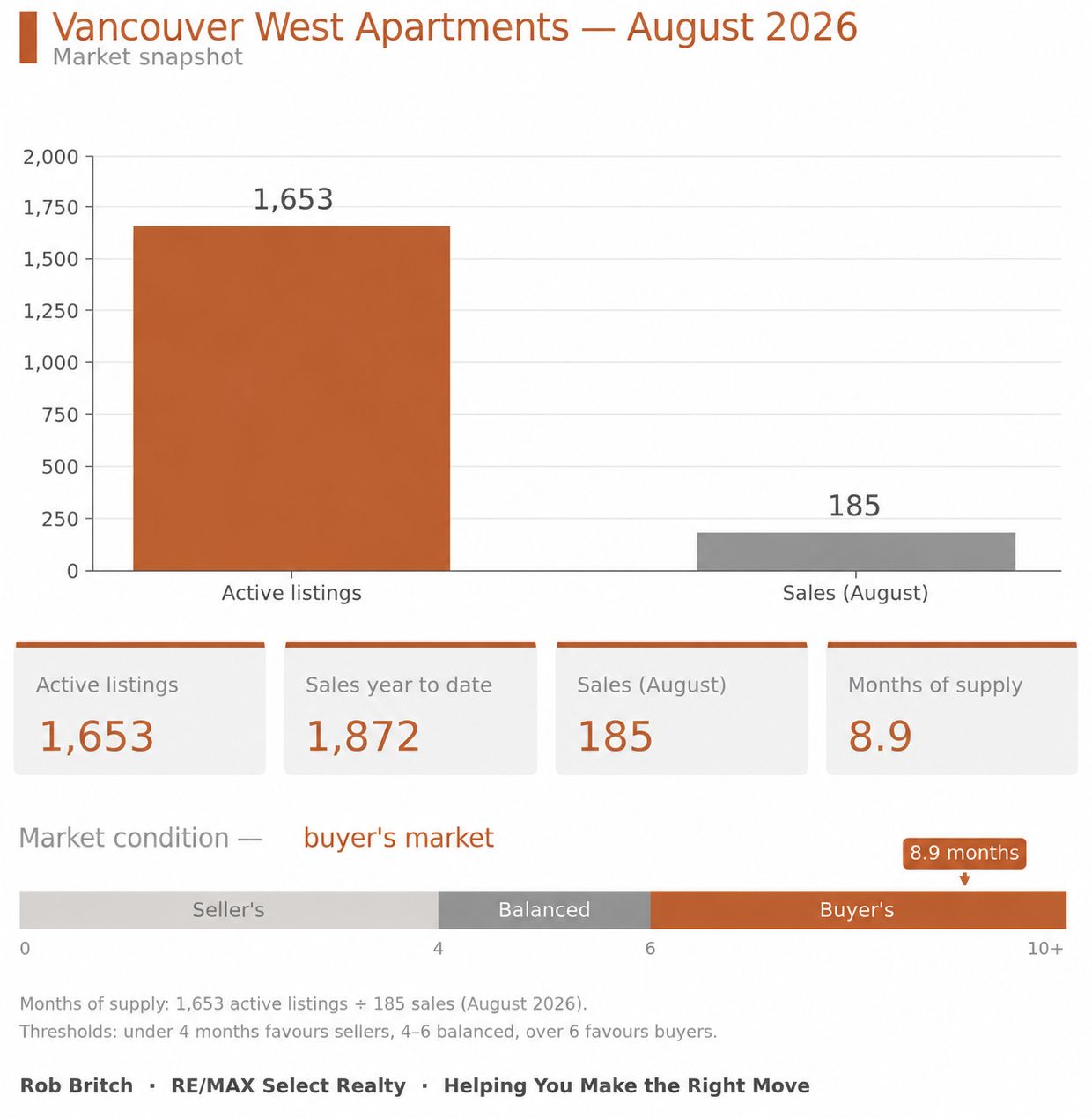
Vancouver West Apartment Report      Here

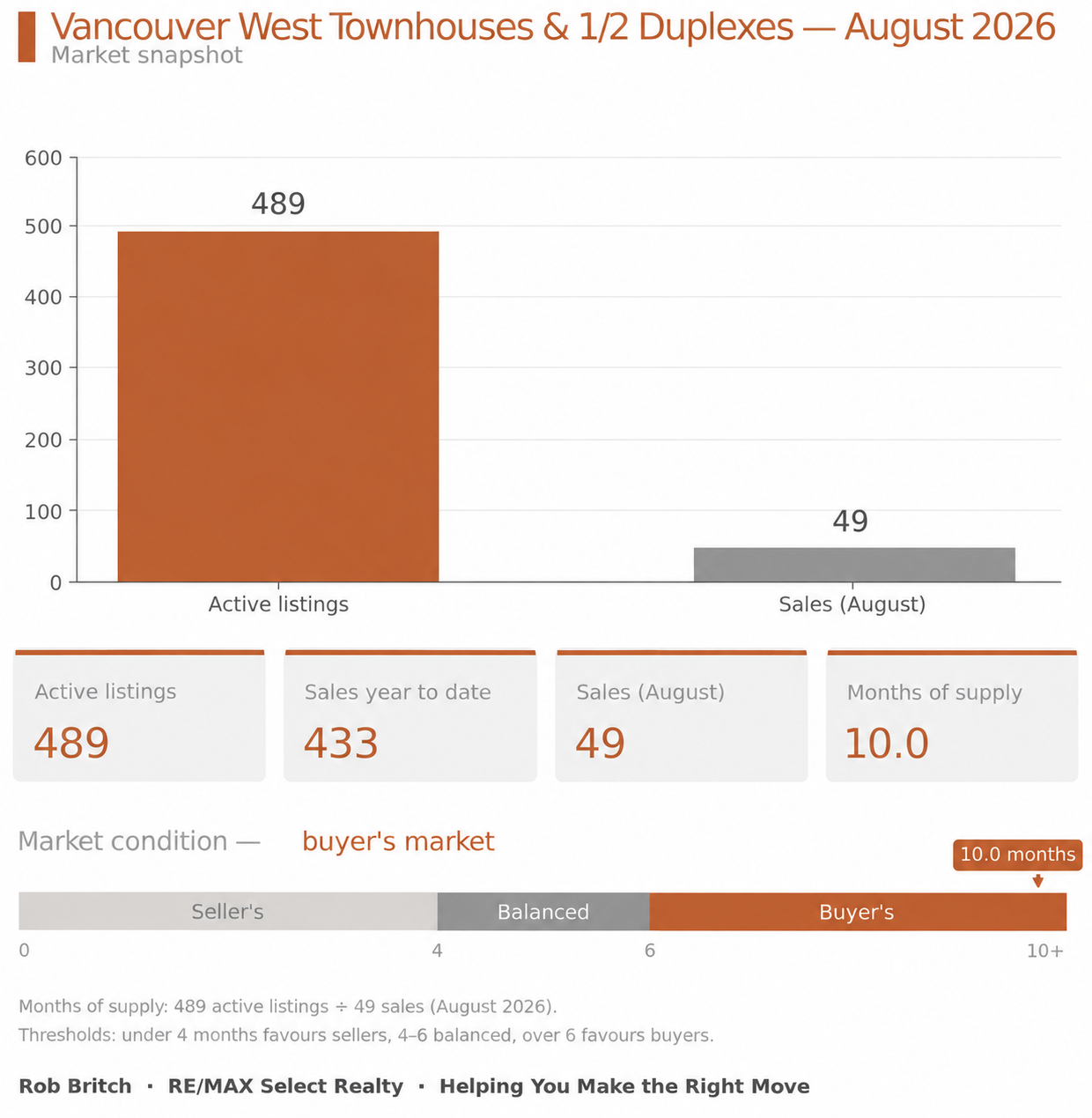
Vancouver West Townhouse Report    here 

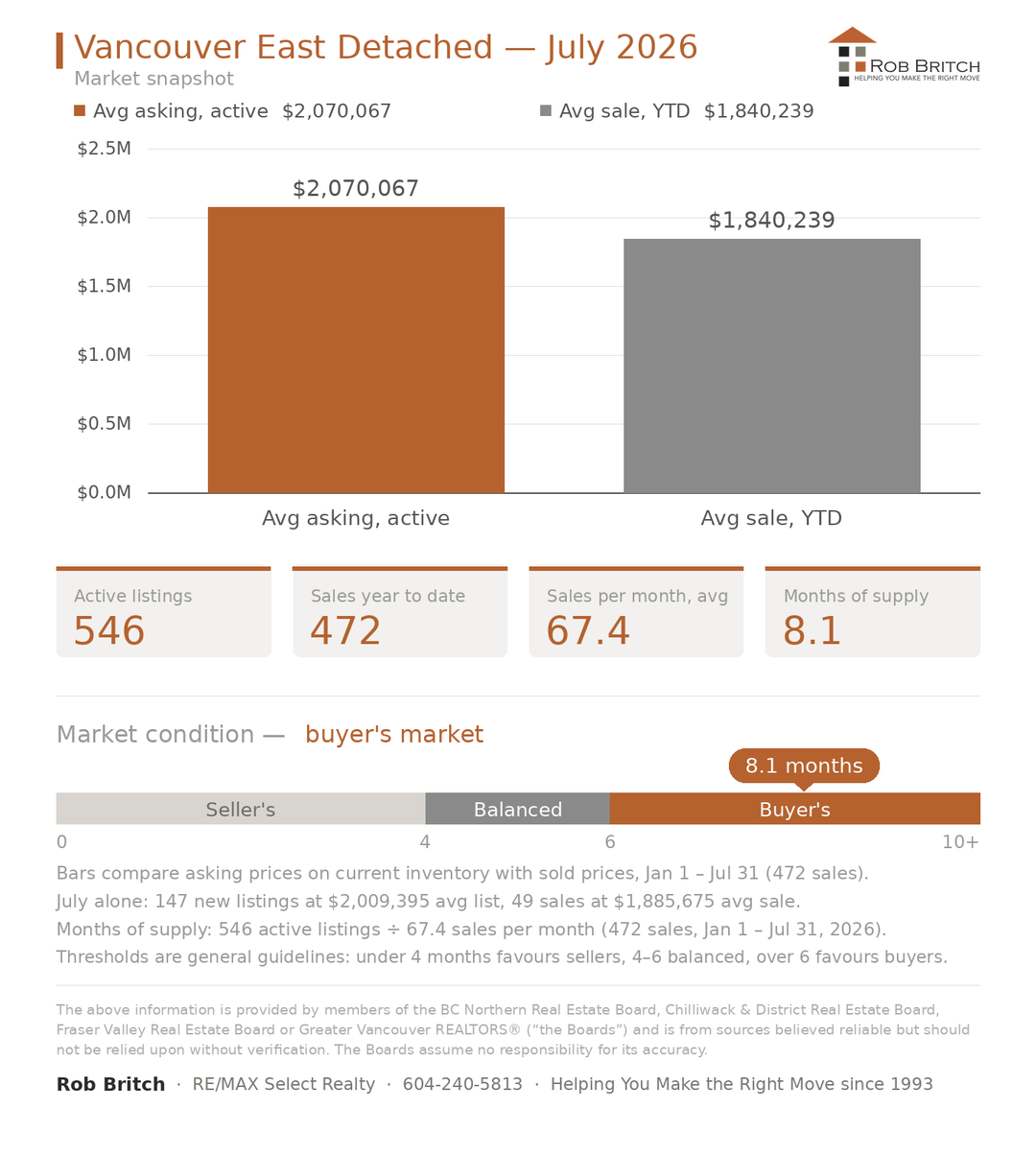
Vancouver East Detached Report          here 

Vancouver East Apartment Report        here

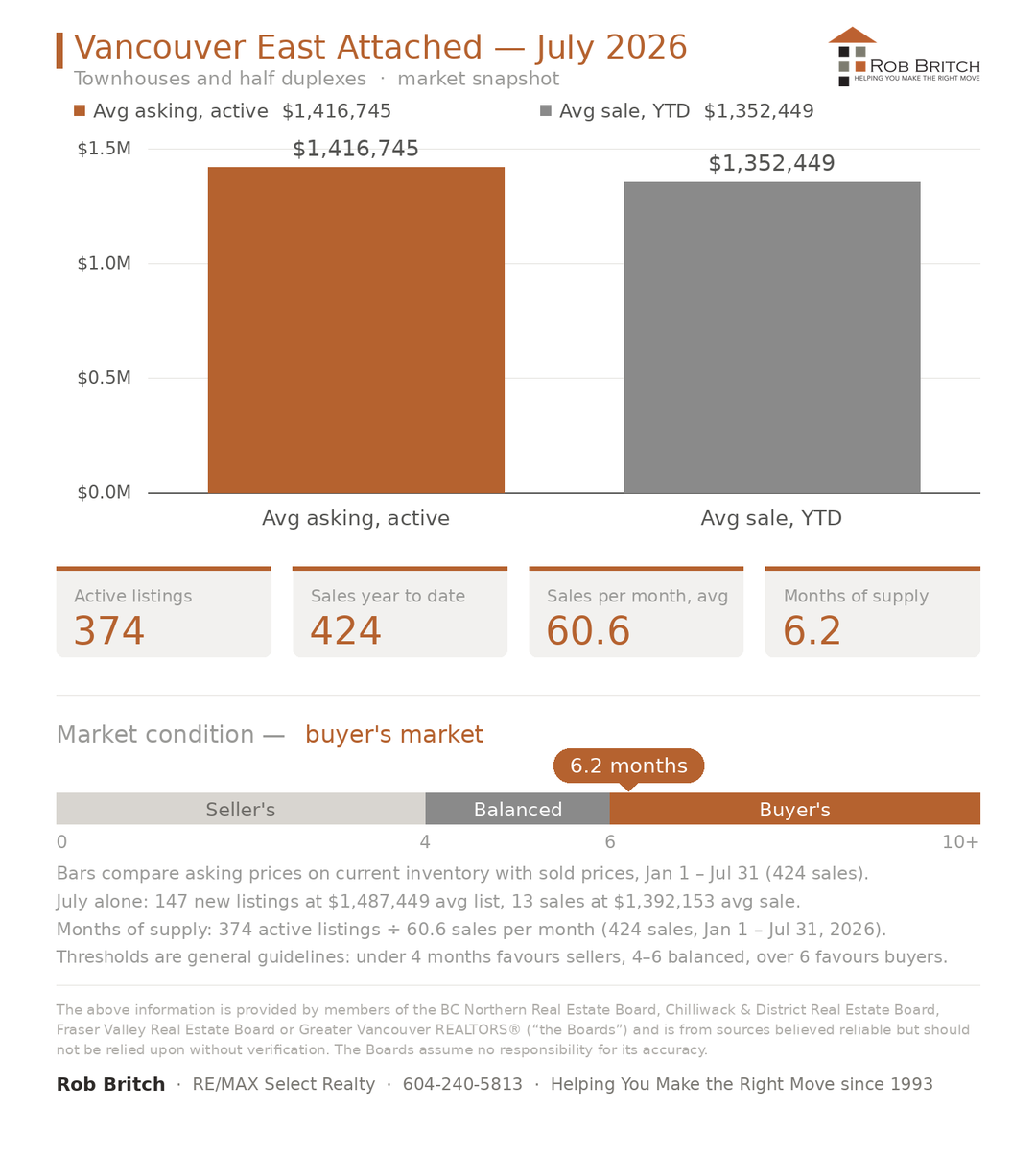
Vancouver East Townhouse Report        here 

The Full Market Report                                 here 

Market Steadies as Year-End Approaches

More Choice for Buyers – More Clarity for Sellers

Metro Vancouver’s housing market remained steady in November, showing signs of a healthier, more balanced environment as we head into 2026. While overall sales were lower than last year, inventory levels continue to rise, giving buyers more options than they’ve had in years and creating opportunities for well-priced homes to stand out.

New listings came in right around seasonal norms, and total inventory is now 36% above the 10-year average, a clear sign that the market is offering breathing room and choice after several intense years. Prices have softened only slightly, suggesting a stable adjustment rather than dramatic swings.

• Benchmark home price: $1,123,700 (down 3.9% year-over-year)
• Sales-to-active listings ratio: 12.6% (balanced-to-buyers’ market range)
• Townhomes remained relatively resilient with a small month-over-month gain.
• Buyers are taking their time—and benefiting from more selection.
• Sellers who price accurately are still achieving strong results.

With borrowing costs expected to hold steady, confidence could improve heading into the spring. Historically, markets that stabilize like this often set the stage for renewed activity early in the new year.

Overall, November reflects a market that is resetting into balance, giving both buyers and sellers a clearer path forward.

Questions about the Market?


Rob Britch | RE/MAX Select Realty
📞 604-240-5813  ✉️ rob@robbritch.com  🌐 robbritch.com
Metro Vancouver Realtor® | 32+ Years of Experience

Read
Reciprocity Logo The data relating to real estate on this website comes in part from the MLS® Reciprocity program of either the Greater Vancouver REALTORS® (GVR), the Fraser Valley Real Estate Board (FVREB) or the Chilliwack and District Real Estate Board (CADREB). Real estate listings held by participating real estate firms are marked with the MLS® logo and detailed information about the listing includes the name of the listing agent. This representation is based in whole or part on data generated by either the GVR, the FVREB or the CADREB which assumes no responsibility for its accuracy. The materials contained on this page may not be reproduced without the express written consent of either the GVR, the FVREB or the CADREB.